Wednesday, November 10, 2010

The ladies only car


Have I mentioned that I LOVE the Delhi metro? It’s extensive and goes to so many places in this incredibly sprawling town (LA listen up!). But the best thing of all about the Delhi metro is the Ladies Only Car to be found at the head of every train going anywhere. I’d say that the ratio of metro users is about 200 men to every one woman, so having the ladies only car is an absolute blessing.

A typical scene at a busy metro station (ie, almost all of them), is men lined up single file in the well marked area where the metro cars will open. I have to confess that I was shocked at this initial orderliness given the chaotic and random nature of lines in pretty much every other context. (This is not the case in the Ladies Only Car section, which is generally roped off, has large pink flowery signs indicating that it is the ladies only section and is often monitored by scary women enforcers. We don’t line up because we all know that we’ll get a seat on the train.) I was impressed by the men’s lines—until I saw what happened the moment the train doors opened. The previously orderly line forms a wall pressing forward with great force because they face their equally aggressive enemy: those getting off the train. I have to admit that even the women tend to rush the opening doors without letting people get off the car first. This is something I will never understand, despite the fact that it happens pretty much everywhere in the world to a greater or lesser degree.

It is with guilty pleasure that I admit to gloating at the heaving mass of men that sometimes, through sheer numbers, spills into the Ladies only car, (there are no proper doors between the train cars, just a narrowing of the walls), that is until one of the enforcers comes along. Woe to the man who breaks that rule! There is one exception that allows the occasional man to enjoy the rarefied air of the Ladies Only Car. The enforcers do not expel the men who carry babies or very small children. If I was a man in Delhi, I would always look around for women with babies so that I could have access to this bastion of loveliness. However, I suspect that only a woman would think of this strategy and, therefore, there are very few men to be seen in my car.

The photograph is of my very charming but much frustrated teachers in the Ladies Only Car who agonized at their dolt of a student who had such amazing difficulty learning to count to five in Hindu. (I can so! Ecg, do, tir, char, pat…or something like that.)

Tuesday, November 9, 2010

The finest money can buy


There are three wine shops in Defence Colony where I live. This is the one with the largest and best selection.

Monday, November 8, 2010

Obama is here!


Yes, yes, I knew he was coming but I simply lost track of the time and all of a sudden he was here! I vowed to avoid all public spaces (actually was warned to do so by those in power), but again I forgot. Besides, I heard he had shut down Lal Qila and I’ve already been there. So sure I was surprised when I eventually found the Raj Path—the Delhi equivalent of the Champs Elysee, replete with its own Arc de Triomphe known as the India Gate. After one wrong turn out of the metro (and really that’s all it takes to become hopelessly lost in this town), which led me to a camp of itinerants with their very own cow tied to the tall wrought iron fence of the Indira Ghandi community arts center, and then a right turn, which did lead me to the remnants of British imperialism. My, was I surprised when I figured out that attached to each and every one of the army of lampposts was an Indian flag—and an American one. Obama was on his way! Even though I knew I was taking my life in my hands, I had to walk the Raj Path all the way to the end, where I had so much fun taking pictures of the people who were taking pictures of a pretty bland tribute to millions of Indian soldiers.

What I know about Diwali


Or what the shopkeeper’s mother told me. I was hanging around some swanky shop while Doris, the anthropologist, was haggling with the shopkeeper to get the price for a dancing Ganesha down. They were haggling in euros so I knew it wasn’t a shop for me. Anyway, the mother at her son’s behest was doing her best to get me interested in some stuff and I played along for a while (it took a really long time to reach the right price point) until it dawned on me that I had a font of information right in front of me! So I pounced.

As a huge fan of Ganesh (I don’t call him Ganesha, though that’s what they call him here) and with my rudimentary knowledge that he had something to do with the festival of lights, I asked her to tell me about Diwali. It turns out that Ganesh is not alone as the only celebrant. His pal Lakshmi, a goddess I’ve never heard of except tangentially because of the news reporter Lakshmi Singh, is pretty key in all of this. He is easy to identify, who can miss the elephant head on a slightly chubby but nonetheless appealing human form. It turns out that she’s easy to identify, too! In the hands of each of her two back arms she holds a lotus.

According to my shopkeeper’s mother, Ganesh is the protector against evil. After a little thought, she decided to put a more positive spin on it, thus he is the destroyer of obstacles. However, most of us know him simply as the god of good luck. Lakshmi’s talents are pretty straightforward. She is the goddess of wealth. The happy couple are seen everywhere these days, he more than she, but the classic ones I’ve seen have all been in temples that don’t allow photographs—or pretty much anything else. My favorite Hindu temple (so far) said that you had to check EVERYTHING—at your own risk. A sample of what was not allowed inside aside: cameras, knives, mobile phones, food (described in excruciating detail), pen, paper, books, pots, cooking utensils, etc (just to be comprehensive). Therefore, all of my photos are from makeshift shrines on the street.

But the real Diwali is about lighting hundreds of tiny oil lamps and candles and a 24 hour non-stop display of personal fireworks. I do confess to loving the enormous sparklers that everyone seems to have, though you have to be pretty strong to spell your name in sparkler over and over until all three feet of the sparkler goes out. I was absolutely delighted to discover on my trip to the National Museum (which REALLY needs a new curator if anyone is interested), a miniature oil painting from Rajasthan with a woman holding an identical sparkler—which was painted in 1660.

Thursday, November 4, 2010

Can we talk Diwali?


I am just in time for Diwali—the Festival of Lights and the most important holiday in Hindu India!! Yes, I am mighty excited about that. Diwali has been described to me as the Christmas of India and I believe it. All of the houses and trees (and pretty much anything that IS nailed down) is covered with Christmas lights. It is GORGEOUS and entirely over the top, and that’s saying something in highly decorative India! It is pretty fantastic to wander around in the evening and see all of the decorated houses. All of this brightness got me to thinking about the limits of electricity and particularly the limits of electricity in India. Where does it come from? How is it distributed? (I know, I know, I should be thinking more festive thoughts but I can’t help myself! I’ll have all day tomorrow to think those thoughts as I will not be working!)

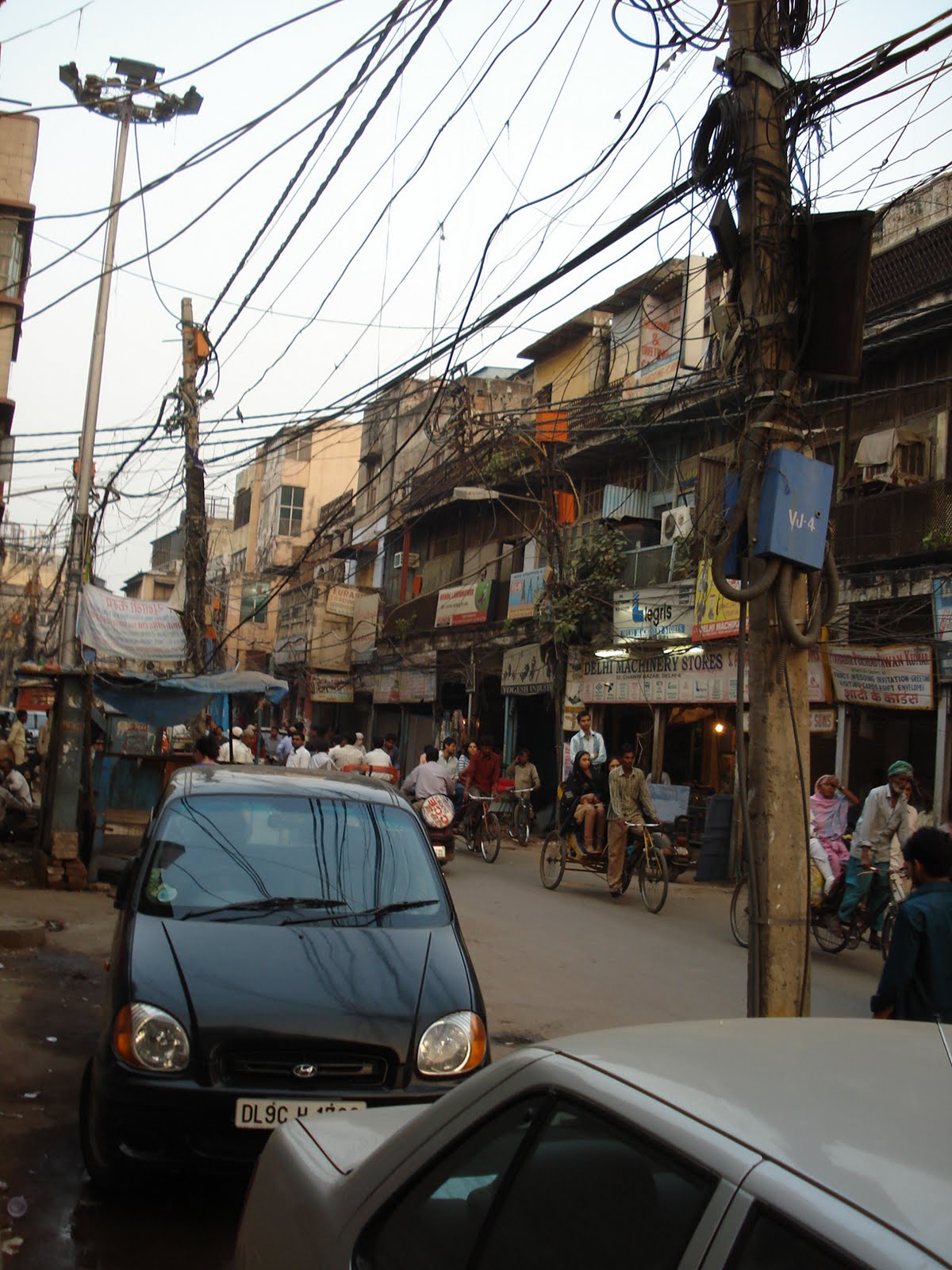
Since the beginning of my stay here, I have been entranced by the electric wiring and power systems that appear in the most unusual places. Consider if you will the ability of these structures to illuminate and power the lives of well over one billion Indians. Now consider the additional energy requirements of the Festival of Lights that create power demands on steroids. I am waiting for Delhi to erupt into a brilliant ball of fire. That will probably happen tomorrow.

Wednesday, November 3, 2010

The mosque across the street


The apartment where I’ve been staying is so full of people right now, that we had to borrow a room in another apartment. I was torn as to whether I should go or not (for some reason I was offered the honor of leaving!?!), but finally opted for a snore-free zone. Good move! When I got here I was delighted to discover that the view from my terrace overlooks the crumbling mosque that I had only seen once before, when in a completely sleep deprived haze after 20 hours of travel, 4 hours of sleep and a full day of work I realized that I would never be able to successfully navigate the labyrinth that I now call home and I took a rickshaw. Ok, how was I to know that the rickshaw driver was as clueless as me. We wandered for a considerable period of time and passed this wonderful monstrosity of a mosque, which I have not seen since!

The mosque appears to be an organic growth as it struggles to survive the greenery that threatens to enshroud it. It’s hard to tell if it is a working mosque, mainly because there is no sound system. In my experience, even the poorest and most remote mosque has a quadraphonic sound system to summon the faithful to prayer five times a day. However the main gate is open and the signage is new. One can only ponder the secrets of the mosque across the street.

Tuesday, November 2, 2010

A typical day in the neighborhood


Destination: Jain Temple in Old Delhi. And what to my wondering eyes should appear but several well apportioned (and well dressed!) horses charging from the heavens. There is a certain urgency given off by tolling of bells with their many ropes hanging from the air to make the clappers accessible. Quick check your shoes with the show watcher across the narrow walk way, pick up a marigold garland to drape around Rama’s neck once you get inside and you’re on your way to contemplation and Nirvana (and a few specific requests to the Gods because that is why they are there after all). After hanging out in the temple a bit, time to go shopping. But remember the Divine is everywhere as little shrines appear sometimes in the most unlikely places.