Wednesday, November 24, 2010

And even more sights!


I like Hajipur. (Victor, you were right.)

Ward rounds at the hospital


MSF has a huge ward for kala azar patients in the central district hospital. The hospital tends to be the place people go when there is nowhere left to go. There were many patients, more than I expected, all serious and concerned about what they could do to make themselves better. Initially people tend to be shy and expect to be treated badly because they come primarily from the most marginalized castes in all of India. Kala azar is definitely a disease of the indigent. You can tell the patients who have been there for more than a few days. Not only do they appear to be significantly healthier than new comers, who are easily spotted on the ward, but they are also unafraid to ask questions about their treatments, which are administered intravenously through a drip, and they are quite comfortable fooling around with the dials on the drip to make it go slower or faster. The best thing, however, is that the medicine is a bright yellow, which means it’s got to be good for you AND is fun to look at! (See! I really am working…)

Tuesday, November 23, 2010

Welcome to Hajipur


Dante’s fifth circle of hell. The only reason that my brain automatically classified it at that level is because there are some imaginable levels left—not many, but some. Apparently the noise has died down since the end of some month long festival, but it remains quite constant and consistently loud modulating briefly down between the hours of two and five in the morning. The soundtrack consists of Bollywood’s greatest theme song hits with an overlay of the Koran sung and shared through powerful loudspeakers and a tinkling metallic sound of an ever present carnival that punctuates the rare moments of silence when both of the principals happen to be taking a breath simultaneously. That sums up the major detraction of the place. Given Hajipur’s proximity to the Ganges, odor could conceivably enter into the mix in a significant way. Mercifully, it does not, hence the rating of five not seven. I’ve learned that noise is legislated in most other Indian states.

That said, I have had my first glimpse of the mythical and immortal Ganges River! It’s huge! At least I think it is from what I could make out through the pollution haze. Have I mentioned that it is a tad polluted in this part of the world? I saw the Ganges far below as we wormed our way across the heavily trafficked yellow-fenced bridge between the capital of Bihar State, Patna, and the Hajipur side of the river. Bihar is the poorest state in India—and that’s saying something. However, the first thing I noticed, after the swarms of pedestrians, rickshaws, small, packed public transport buses, cars and trucks that endlessly deadlock the streets, is the defiance of the people against poverty through the insistent use of color and design.
Every rickshaw, no matter how battered, is painted with flowers or gods or lovers and has embroidered tapestry shelters under which the patrons may repose against the mid-day sun. The apparently mandatory words on the back of each and every truck ‘BLOW HORN’ (and they liberally follow this advice) are painted in many colors in everything identifiable style from art deco to Islamic design, each letter perfectly spaced between the iron supports that hold together the back doors of the identically designed Tata trucks that monopolize the roads. The people that line the sides of the roads and fill all vehicles are dressed in a riot of colors that makes Delhi look tame and that stand out brightly against the backdrop of lush green banana trees, palms and densely impenetrable green plants that fill in empty spaces along the road.

Saturday, November 20, 2010

I LOVE Lajpat Nagar Market


Indian markets are not like other Asian markets. There are no quaint stalls under tents or open air structures. Rather the market place is filled with tiny shops, often several creative levels of shops that all have street visibility through the clever placement of steps and ceilings. That’s the structure, then there is the absolute eruption of goods flowing into the pedestrian pathways (one can hardly use the term sidewalk, but the various piles of rubble and occasionally spotted workmen suggest that maybe someday there will be sidewalks).

I arrived innocently enough to buy fabric for the trousers I’m having made by the exquisite Mr. Shiv (more later on this talented man—for now suffice it to say that I am having much more luck with my Indian tailor than I did with my Malawian tailor). That’s all I was going to buy. I keep telling myself that I’m saving myself for Rajasthan where there are items of such exquisite beauty at such an excellent price that I won’t be able to control myself (and I’ll be on holiday, which is always a sure indicator of the need to spend more money than intended). Apparently I’m in training for this loss of control when it comes to shopping. I bought SO MUCH stuff today. But the most agonized purchase (of course the most expensive) was a new pair of glasses frames. I tried on every pair in the shop and simply freaked out at the cost—until I did the math and realized that the cost was $30, for something that I would pay $300 at home. Is this the rationalization process for all spending sprees?

The best carrot ever


In spite of all evidence to the contrary, I am indeed working very hard here in India. Yesterday I finished the first draft of a detailed 45 page technical report. Quite honestly I’ve been working like a dog (though in a great deal of denial about this fact since there is so much I want to see and do here and it is still an adventure walking home every night!). Beginning on Thursday, once it came to my attention thanks to the elegant, curious visiting Australian, Sally, I began fantasizing about Verma’s. That would be my carrot. I would get some beauty treatment to restore my soul after countless hours slaving on my report. (On leishmainaisis—aka kala azar, an extremely debilitating vector borne neglected tropical disease that affects a billion poor people worldwide. Come on! You knew I was a do-gooder, a hedonistic do-gooder, but a do-gooder nonetheless.) Shortly after lunch on Friday, Sally dragged me to Verma’s Beauty Salon, established 1958, to make an appointment for after work. Not only was I going to get a beauty treatment, but I was going to insure that I had my work done in a timely fashion!

So inspired was I by this carrot, that I finished an hour early and paced the floor in anticipation of the Verma treat. Now I could have got a basic facial for the low, low price of 300 rupees (about US $6)—and I’m sure that would have been fine. But no, I decided to splurge a little and go whole hog. I got the Lotus Special Facial and Massage and for the next hour and a half I had various and sundry oils and unguents squirted on me or delivered by the breadknifeful by a very talented woman who I chose to believe was Verma herself. HEAVEN!! And all for $14. I’m pretty sure I’m going to become a regular at Verma’s.

Tuesday, November 16, 2010

Moghuls got it going on


At least they did at some time in the past. Delhi is absolutely littered with tombs of Very Important People who thought very highly of themselves. I do have to say that they built things made to last. It turns out that Delhi is really a convergence of seven cities linked together over time and now simply linked by sprawl. Each of the original seven cities, which started to really be cities about a thousand years ago, is commemorated either by a tomb complex (by far the more popular choice) or by a fort—there are two: the old one and the red one.

The red one (Lal Qila) is by far the more impressive one, but the old one (Purana Qila) has some serious charms not least of which is that it was originally built in the 12th or 13th century. It is a low prestige fort relatively speaking and pretty darn hard to find. Everyone and I mean everyone who is anyone was hanging out at the World Heritage site that is Humayun’s tomb (a name that does not come trippingly off my tongue, I’m not sure why). Yet a mere three or four of the some of the least pleasant kilometers I have ever walked in my life lies Purana Qila. Behind the zoo. Hidden. There were no westerners here, but there was a sprinkling of Indians, mostly couples seeking solitude (a rare grace in this town) and people with families who were either burned out by the zoo or realized that their emotional and mental stamina were simply not up to the task of stinky animals and hordes of people. No it is a very select group who comes to the Old Fort.

Because there are ramparts and ramparts always look down on something, they were irresistible and we had to climb them—right out on to a limb. Climbing is right! Like most everything else in Delhi this place is under refurbishment. The main focus of refurbishment is always the 100 or so meters that the typical tourist—foreign or Indian—is willing to walk. However, the sights and sounds below the ramparts were their own reward, though even high above the world, I am still the object of attention. Did I mention that I feel like a movie star here? Everyone takes my photo, with their phones, with a camera, usually quite blatantly. I suspect that I am prominently displayed in many Indian homes at this point and am simply known as ‘My friend, who is not from India.’

The photos are mostly of the Tomb (including the graffiti, which is everywhere, but I’m dying to know what wers means), the Barber’s Tomb (barber to Humayun—must have been one dynamite barber!), and a view from the ramparts.

Sunday, November 14, 2010

Laksmi Temple World


I can’t believe it! Incredilbe !ndia and I’m two for two on dud temples. This sort of thing doesn’t happen in this part of the world. The first dud is beautiful in a carnivorous flower kind of way. It is the Lotus Temple. I thought it was Buddhist or possibly Hindu, but I was wrong on both counts. It is a Bahai temple (I know there’s supposed to be an apostrophe in there somewhere I’m just not sure where). First of all I have to admit that it’s pretty impressive if you’re into late 2oth century architecture. It’s this enormous white marble pointy structure that you know looks like a lotus because you have been prepared in many ways for it to be so. As we waited in line to enter the sacred structure, a woman who was mercifully downwind and difficult to hear was trying to convert everyone standing on line, in a low key manner, but still this was the first active recruitment effort I’ve experienced in a while. Although we were all sworn to silence the better to meditate, there was something uninviting and unsettling about the 1000 squeaking wooden chairs and the hundreds of people struggling to keep themselves and their children silent. I walked around the edges and was mighty surprised to see some fire and brimstone messaging—all in English—from the Bahai who promote interreligious tolerance. I was quickly ready to leave and walk the unkempt park grounds that surround the place—much more my style.

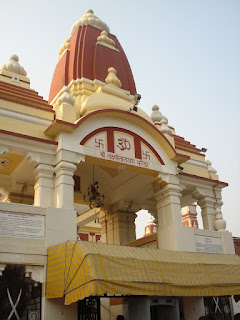
The very next day I went to try once again—my third try!—to visit Lakshmi at her temple. This is another one of those hard to get places in the middle of nowhere (an underlying theme in this town, which I continue to love anyway). After going through that bastion of colonial British architecture (Connaught Place--eewww), we finally figured out the right road to take. A few kilometers and twists and turns later, we found ourselves in front of a pink and white birthday cake appearing temple covered in swastikas. Hmm. Ok not REAL swastikas, ones that go in the opposite direction but for western eyes it’s all the same. Go through the procedure of the metal detector, a frisk if you look suspicious, check your shoes because you must be barefoot to enter a temple and join the crowd begging Lakshmi (goddess of wealth you will recall) for a change in life circumstances. The deities were of the slightly pink and slightly blue variety but not the elegant ones carved in older temples (alas this temple too is less than 20 years old). These representations reminded me of dolls offered as carnival game winnings. I think some very powerful Hindu lobby managed to get this place on the Delhi tourist map. Yet, when all hope was I lost, I happened to look out of the back of the temple—and a miracle appeared!!!

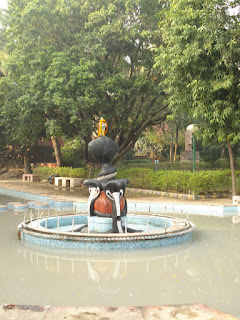
It is unclear whose brainchild Lakshmi Temple World is, but man it is good!!! The park of Lakshmi Temple is a somewhat abandoned theme-park, blue lined pools with fountains that have never functioned, the water dark and milky (perfect breeding ground for malarial mosquitoes—hey, I’m a public health professional!), surrounded by a garishly painted fiberglass menagerie. The Disney-esque cobra fountain was my personal favorite and of course the obligatory elephant and tiger, but the black bear and rhino were clearly the imaginings of someone who has only ever heard of these beasts as described by return far-away travelers. Another prized item in the park is the light-whirling electric fortune telling and weight measuring scales placed prominently, though randomly, throughout the park. My fortune told me that I am creative, energetic, generous and true in love (Genelia© Northern Scales Co, New Delhi fortune number 0223389).